
External Affairs Minister S M Krishna has said that the country has taken a 'principled' stand on the Comprehensive Nuclear Test Ban Treaty (CTBT) and there is no scope for change in its position unless a number of other developments take place to address the concerns.This comes after a high-level conference on disarmament in the United Nations on Thursday, addressed by UN General Secretary Ban Ki Moon, asked India and eight other countries to ratify the agreement.

"The pursuit of clandestine activities in respect of nuclear technologies is unacceptable and dangerous. All States must transparently live up to the international commitment that they have undertaken," he said at the conference 'Towards a World Free of Nuclear Weapons'.
Hundreds of young men and women from all over the world, including India, took part in the sixth youth assembly at the United Nations that stresses the importance of engaging youth to help achieve its Millennium Development Goals.
India has sought an 'unequivocal commitment' from all nuclear-weapon states to prohibit development, production and stockpiling of nuclear weapons for their non-discriminatory and verifiable elimination within a specified framework. Indian Ambassador to the UN, Nirupam Sen appealed to member states to use the UN forum for an intense dialogue and strengthen the international community to initiate concrete steps for a nuclear weapons-free world.
The nonproliferation and disarmament lobby in the United States, which has been vehemently opposed to the India-US civilian nuclear agreement, is ready to pop open the champagne to celebrate.The nonproliferation lobby is elated as the demise of the agreement is close at hand, with even senior members of the Bush administration acknowledging that the clock has all but run out on the deal.
Terming Prime Minister Kevin Rudd's initiative of setting up nuclear disarmament commission as "half-baked", Australia's opposition party has said it was "an excuse to continue the ban on uranium sale to India".
Robert McNamara, who served as the US defence secretary during the controversial Vietnam war and the Cuban Missile Crisis, died on Monday in Washington at the age of 93.
Pakistan said that the incipient United States-India nuclear deal has spelled concerns in Islamabad over maintenance of strategic stability in the region, but that it will keep the balance despite its opposition to arms race.
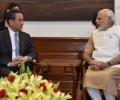
Wang and Swaraj also discussed issues relating to annual BRICS summit which will be hosted by India in Goa in October.
More than 130 experts and non-governmental organisations from 23 countries have criticised the Ind0-US nuclear deal, saying its proposal to exempt India from the long-standing global nuclear trade standards "would damage the already fragile nuclear nonproliferation system and set back efforts to achieve universal nuclear disarmament".
Nobel Laureate Wangari Mathai was on Monday awarded the Indira Gandhi Prize for Peace, Disarmament and Development at a function at Rashtrapati Bhavan where a call was made to the developed world to join hands in adopting eco-friendly practices and tackle climate change and greenhouse gas emissions.
Even as the United States Senate has scheduled a quick hearing on the India-US nuclear deal, all eyes are on the House of Representatives whose Foreign Affairs Committee Chairman Howard Berman, a vocal critic of the pact, is yet to take a call on having a similar process."Secretary of State Condoleezza Rice has been lobbying furiously for the India deal, which appears to hinge on whether the White House can persuade Republican Howard Berman," said a local paper.
India has sought total elimination of nuclear arms backed by a security system in which states do not feel the need to develop, produce or stockpile them.
India's credibility for initiating such a campaign will now be particularly high as it itself had become a nuclear weapon power, said India's Special Envoy for West Asia and the Middle East Peace Process.
"Situation of weaponisation and associated dangers have not changed much from the cold war days," John Hallam, a veteran anti-nuclear weapon campaigner and Friends of Earth, Australia member said.
Australia, in a bid to take a leading role in getting a global ban on nuclear weapons, may ask the non-Nuclear Non-proliferation Treaty signatory nations like India and Pakistan to join its newly set up nuclear disarmament commission. "Australia, being the world's biggest uranium supplier with a track record of its engagement over a range of nuclear issues, is well-equipped to play some kind of leadership role here," said Gareth Evans, who will co-chair the commission.
"The Democrats will continue efforts to operationalise the Indo-US nuclear deal after coming to power and will work together for the cause of much warranted global disarmament," he said.
If India feels it is necessary to conduct a nuclear test because of the geo-political situation, India will do it, External Affairs Minister Pranab Mukherjee told the Rajya Sabha.
Some Chinese scholars wondered why India is not taking any initiative to join NPT and which will open up more options for the nation on the nuclear front.

'Only when India's adversaries are convinced that India has both the necessary political and military will and the hardware to respond to a nuclear strike with punitive retaliation that will inflict unacceptable loss of human life and unprecedented material damage, will they be deterred,' says Brigadier Gurmeet Kanwal (retd).
The decision is significant as it comes in the midst of India's efforts to lobby support in the international community for its civil nuclear energy ambitions.
The prime minister said given the circumstances, India needed a strategic nuclear weapons programme.
The consequences of not signing the NPT are well known. However, India should be prepared for the consequences of not going along with US on the discussions leading to the FMCT.
'There is no doubt that the US would like all their friends to agree with them. We are not in the habit of doing that,' says former diplomat Arundhati Ghose.
Russia has indicated its willingness to back United States' amendments to Nuclear Suppliers Group guidelines.
India views the developments along Afghanistan's "south and south-east border" (Pakistan) as "disturbing" and will try to ensure that the UN maintains its focus on curbing the activities there that pose a threat to the entire world.
'It is because of Chinese policy that Pakistan is nuclear. So we have to look at it as one unit. If the fissile material of Pakistan is to be controlled, you have to control China,' says former diplomat Arundhati Ghose.
'The new phase of intensive engagement with the United States will have its own challenges and rewards.'
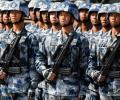
'This is the first time that active PLA army personnel would be reduced to below one million,' PLA Daily said.

China, while blocking India's entry into the NSG previously, has called for a two-step plan that stipulates the need for the NSG members to arrive at a set of principles for the entry non-NPT states and then move forward discussions of specific cases.

The US president praised Kim as "very open" and "terrific", despite the glacial pace of progress toward denuclearisation on the Korean Peninsula.
They will help pursuing research on issues like panchayati raj, women's empowerment and nuclear disarmament, subjects close to the heart of the late leader.
Indo-US Joint Statement continuation of pro-US shift: Left parties

The MEA said Singh's visit to Pyongyang was at the invitation of North Korean government.

'An ardent advocate of nuclear disarmament, Obama may even be secretly heaving a sigh of relief that the NSG is unlikely to reach unanimity of opinion on India's candidature,' says Ambassador M K Bhadrakumar.
 © 2026 Rediff.com - Advertise with us - Disclaimer - Privacy Policy - Sitemap - Feedback - About us - Terms of use - Grievances